Active System for Fume Hoods by TopAir Systems, Inc.
Reducing Energy Consumption & Saving Money
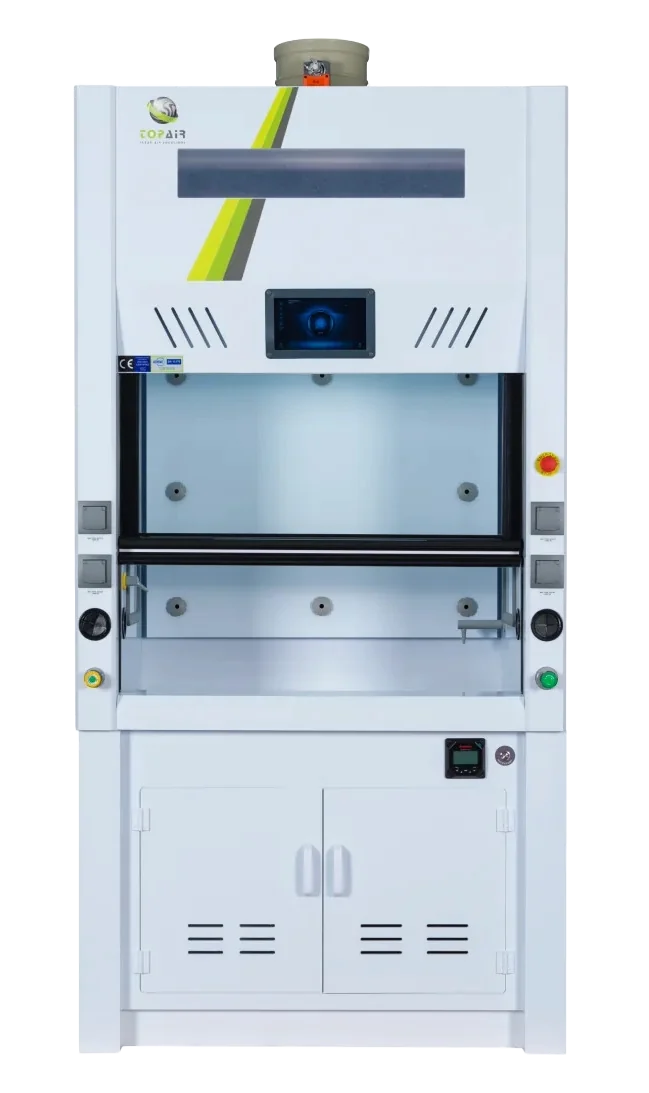
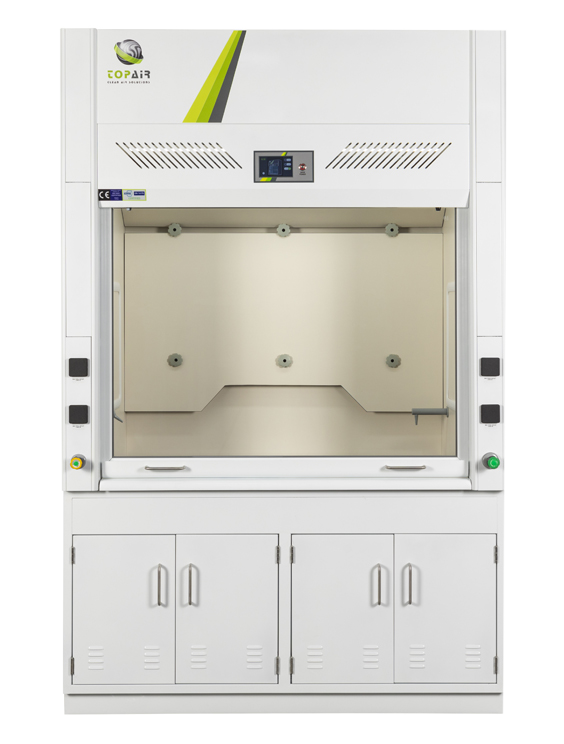
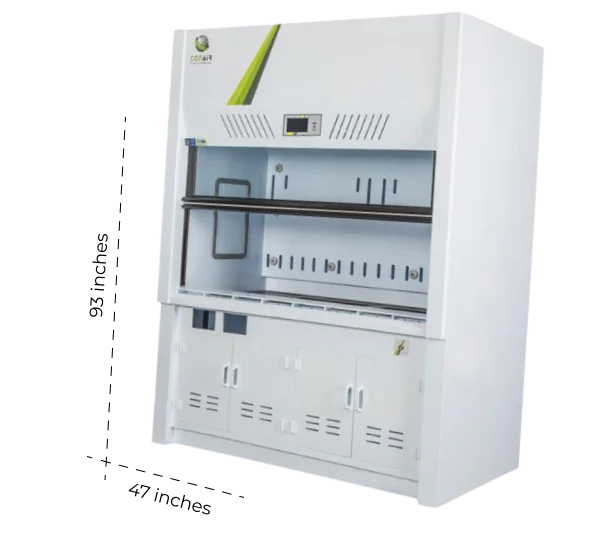
A fume hood is an enclosure that safely contains and ventilates hazardous fumes, vapors, gases, and dust generated by chemical processes performed in the working area. Two main types of fume hoods exist, ducted and recirculating (ductless). Most fume hoods, for industrial purposes, are ducted. A large variety of ducted fume hoods exist. In most designs, air-conditioned treated air (i.e., heated or cooled) air is drawn from the lab into the fume hood through the front opening of the cabinet and then dispersed via ducts into the outside atmosphere.
The air that fume hoods remove must be replaced by fresh air. Because fume hoods expel a large amount of air outside the building, conditioned make-up air must be transported into the facility to maintain a proper air balance. If no make-up air is provided, you will experience worsened air quality, shortness of breath, and a strong negative pressure in the lab. This make-up air has to be treated in some way, heated or cooled, according to location and season. Using all that make-up air, only for it to be expelled out of the facility, will skyrocket the facility’s energy consumption. After years of using the fume hood, you will realize that much of the cost of the hood is conditioned make-up air, and not the cost of the fume hood itself.
Constant Air Volume - CAV Fume Hood
CAV primarily relies on the front sash height position. The constant velocity hood is always pulling air from the facility at the same rate. Therefore, changing the airflow is controlled by the position of the sash (window) on the front of the fume hood.
Since the typical fume hood in US climates uses 3.5 times as much energy as a home, the reduction or minimization of exhaust volume is strategic in reducing facility energy costs.
When buying a fume hood, one must realize that the initial payment for the hood is only a fraction of the true amount it
costs to operate the hood. Significant long-term savings can be made by reducing the exhaust speed and flow of the fume
hood through an active VAV system, which will reduce energy consumption.
Variable Air Volume - VAV Fume Hood
VAV hoods monitor and control the amount of air being exhausted from the room. VAV hoods change the exhaust volume using different methods, such as a damper or valve in the exhaust duct that opens and closes based on sash position, or a blower that changes speed to meet air-volume demands. In addition, VAV hoods feature monitors and/or alarms that warn the operator of unsafe hood-airflow conditions.
Although VAV hoods are more complex than traditional constant-volume hoods, and correspondingly have higher initial costs, they can provide considerable energy savings by reducing the total volume of conditioned air exhausted from the laboratory.
The goal of the VAV system is to maintain an airflow of 100 feet per minute (FPM) no matter if the sash is fully open, half-open or closed (in a fume hood the sash cannot be fully closed). An added benefit of the VAV system is that when the sash is closed the system will continue to maintain an airflow of 100 FPM, however, the amount of air exhausted will reduce dramatically, leading to further savings.
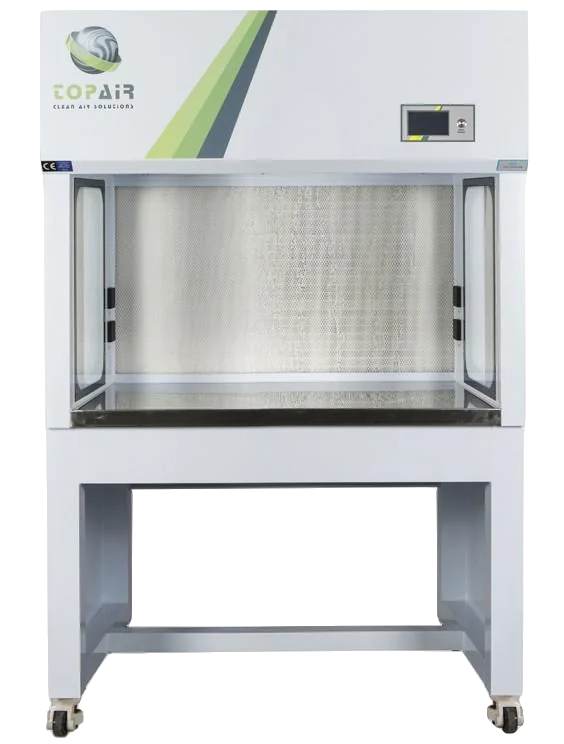
TopAir's VAV System introduces an entirely new concept for intelligent operation of fume hoods. As a complete solution, all its components are already integrated, configured and programmed - a true plug-and-play system, eliminating the need to separately purchase a control system. The VAV system offers facilities a cost-effective solution.
The VAV system is comprised of:
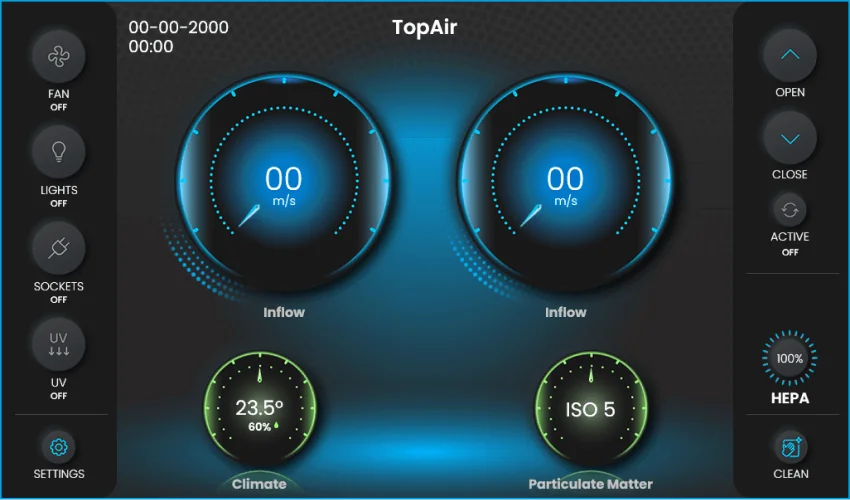
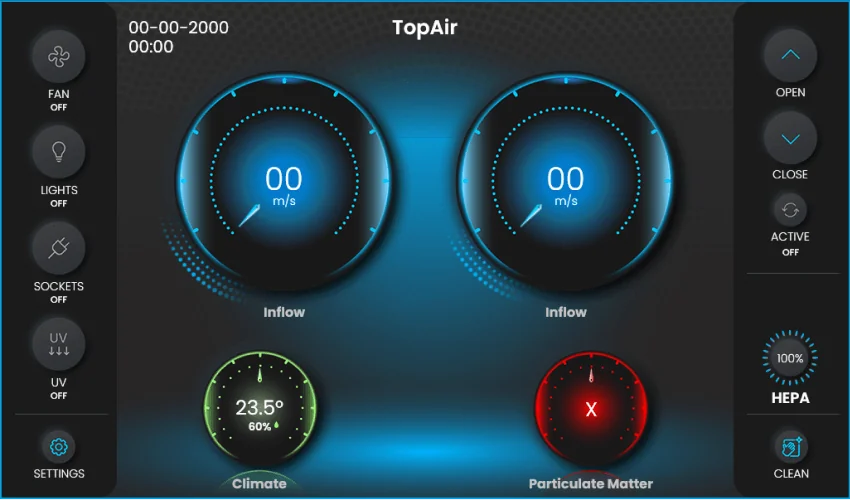
- A touch screen including visual and audio indicators for alerts, as well as a mute button.
- VFD (Variable Frequency Drive) which controls the frequency and voltage supplied to the motor.
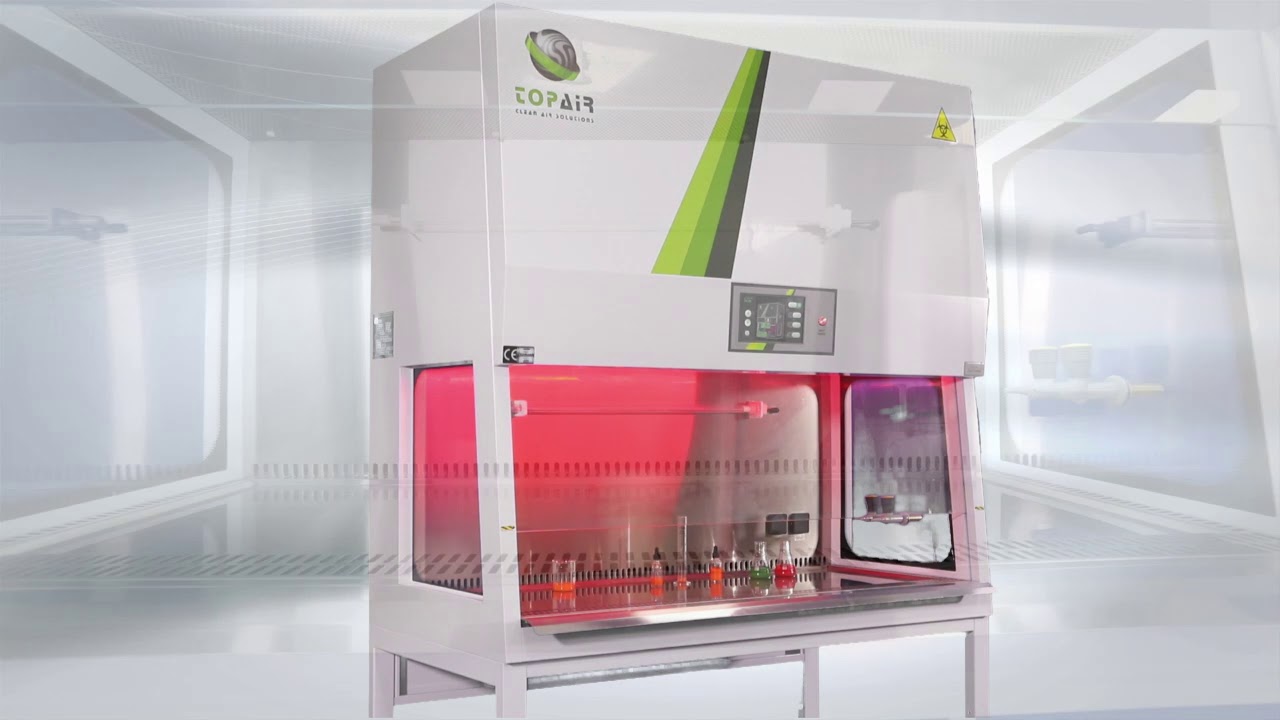
- Safety Alarm - Upon failure, the interior of the cabinet is lit up in bright red so that staff can easily detect the failure from a distance.
The VAV system is a highly reliable and user-friendly system for setup and use. The system can be installed in research labs, healthcare facilities, life sciences companies, universities, and more.
To get the most out of the VAV system, and increase energy savings, one needs to make sure the sash is closed as much as possible. To achieve this, one needs to find a foolproof system that closes the sash whenever not being operated on.
The foolproof way to close the sash whenever not operated on is
TopAir’s Active System.
TopAir’s Active System Fume Hood
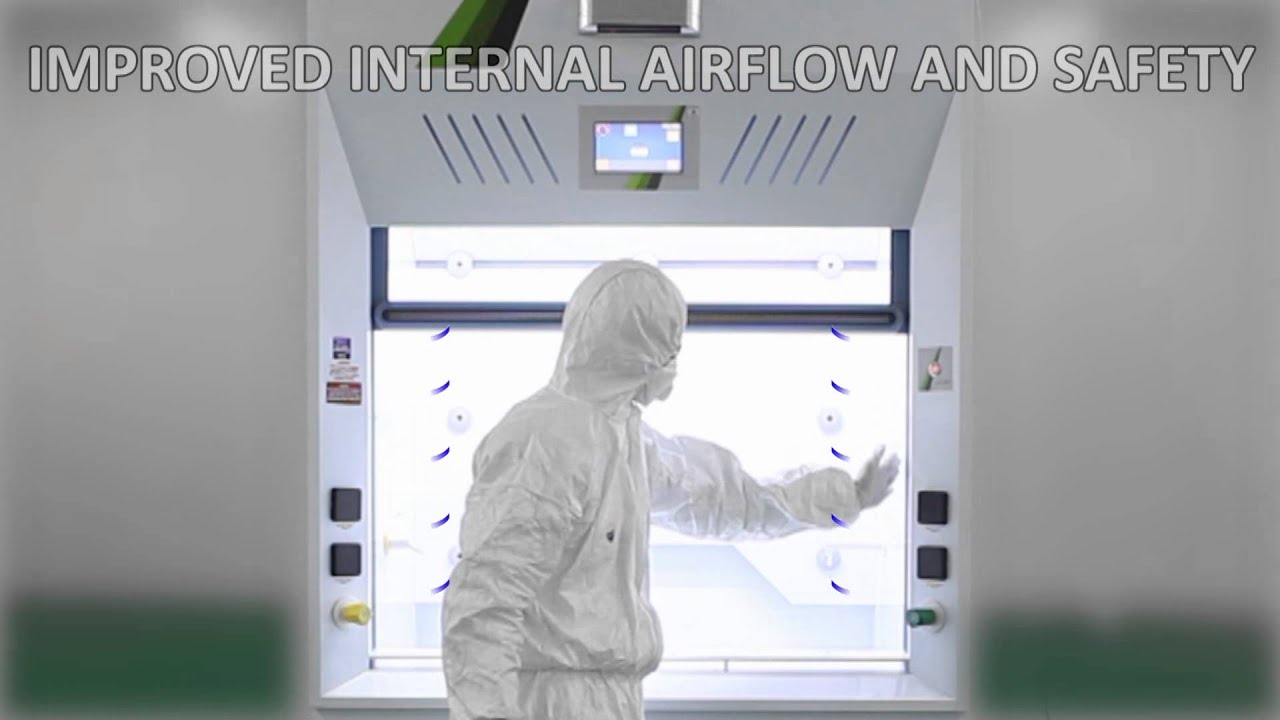
The Active System is a system that includes a motion sensor installed at the top of the unit. If the sensor senses no operator in front of the unit, the sash will automatically close to the maximum lowest position.
The Active system is an additional system to the VAV and works along with the VAV system. When the sash is closed (automatically with the Active system), the VAV system reduces the fan speed, while still maintaining an air velocity of 100 FPM.
The way to maximize use of both the VAV and Active system is to integrate the two. This system enables maximal energy savings by closing the front sash and adjusting the fan speed to the changing needs, as a result, less make up air is needed so most of the savings are enabled around air conditioning.
The system always keeps the user updated as to the airflow speed and provides alerts on deviations from the required speed to prevent hazardous situations.
Energy Savings Calculation
The following statistics were made by taking 5 cities in varying regions of the U.S and comparing the cost of energy in each city against a 5ft (150cm) CAV fume cupboard and a 5ft (150cm) Active fume cupboard. This study was calculated based on an average of 260 working days per year in the U.S.
Fume Cupboard Sash Opening - 51.2" x 25.6"
Annual Fume Cupboard Energy Costs
| Conservative Scenario - 9 hours of working in front of the fume hood per working day |
|
|
| City |
New York City |
Los Angeles |
Orlando |
Boston |
Houston |
|
|
| CAV Fume Cupboard |
$8,066 |
$8,673 |
$7,195 |
$10,207 |
$6,076 |
|
|
| Active - Conservative Scenario |
$3,691 |
$3,934 |
$3,339 |
$4,552 |
$2,889 |
|
|
| Annual Savings |
$4,375 |
$4,739 |
$3,856 |
$5,655 |
$3,187 |
|
|
|
|
| Semi-Conservative Scenario - 7 hours of working in front of the fume hood per working day |
|
|
| City |
New York City |
Los Angeles |
Orlando |
Boston |
Houston |
|
|
| CAV Fume Cupboard |
$8,066 |
$8,673 |
$7,195 |
$10,207 |
$6,076 |
|
|
| Active - Semi-Conservative Scenario |
$3,164 |
$3,362 |
$2,875 |
$3,875 |
$2,504 |
|
|
| Annual Savings |
$4,902 |
$5,311 |
$4,320 |
$6,332 |
$3,572 |
|
|
|
|
| Optimal Scenario - 5 hours of working in front of the fume hood per working day |
|
|
| City |
New York City |
Los Angeles |
Orlando |
Boston |
Houston |
|
|
| CAV Fume Cupboard |
$8,066 |
$8,673 |
$7,195 |
$10,207 |
$6,076 |
|
|
| Active - Optimal Scenario |
$2,638 |
$2,297 |
$2,410 |
$3,199 |
$2,118 |
|
|
| Annual Savings |
$5,428 |
$6,376 |
$4,785 |
$7,008 |
$3,958 |
|
|
|
|
Active System for Fume Hoods by TopAir Systems, Inc.
Reducing Energy Consumption & Saving Money
A fume hood is an enclosure that safely contains and ventilates hazardous fumes, vapors, gases, and dust generated by chemical processes performed in the working area. Two main types of fume hoods exist, ducted and recirculating (ductless). Most fume hoods, for industrial purposes, are ducted. A large variety of ducted fume hoods exist. In most designs, air-conditioned treated air (i.e., heated or cooled) air is drawn from the lab into the fume hood through the front opening of the cabinet and then dispersed via ducts into the outside atmosphere.
The air that fume hoods remove must be replaced by fresh air. Because fume hoods expel a large amount of air outside the building, conditioned make-up air must be transported into the facility to maintain a proper air balance. If no make-up air is provided, you will experience worsened air quality, shortness of breath, and a strong negative pressure in the lab. This make-up air has to be treated in some way, heated or cooled, according to location and season. Using all that make-up air, only for it to be expelled out of the facility, will skyrocket the facility’s energy consumption. After years of using the fume hood, you will realize that much of the cost of the hood is conditioned make-up air, and not the cost of the fume hood itself.
Constant Air Volume - CAV Fume Hood
CAV primarily relies on the front sash height position. The constant velocity hood is always pulling air from the facility at the same rate. Therefore, changing the airflow is controlled by the position of the sash (window) on the front of the fume hood.
Since the typical fume hood in US climates uses 3.5 times as much energy as a home, the reduction or minimization of exhaust volume is strategic in reducing facility energy costs.
When buying a fume hood, one must realize that the initial payment for the hood is only a fraction of the true amount it costs to operate the hood. Significant long-term savings can be made by reducing the exhaust speed and flow of the fume hood through an active VAV system, which will reduce energy consumption.
Variable Air Volume - VAV Fume Hood
VAV hoods monitor and control the amount of air being exhausted from the room. VAV hoods change the exhaust volume using different methods, such as a damper or valve in the exhaust duct that opens and closes based on sash position, or a blower that changes speed to meet air-volume demands. In addition, VAV hoods feature monitors and/or alarms that warn the operator of unsafe hood-airflow conditions.
Although VAV hoods are more complex than traditional constant-volume hoods, and correspondingly have higher initial costs, they can provide considerable energy savings by reducing the total volume of conditioned air exhausted from the laboratory.
The goal of the VAV system is to maintain an airflow of 100 feet per minute (FPM) no matter if the sash is fully open, half-open or closed (in a fume hood the sash cannot be fully closed). An added benefit of the VAV system is that when the sash is closed the system will continue to maintain an airflow of 100 FPM, however, the amount of air exhausted will reduce dramatically, leading to further savings.
TopAir's VAV System introduces an entirely new concept for intelligent operation of fume hoods. As a complete solution, all its components are already integrated, configured and programmed - a true plug-and-play system, eliminating the need to separately purchase a control system. The VAV system offers facilities a cost-effective solution.
The VAV system is comprised of:
- A touch screen including visual and audio indicators for alerts, as well as a mute button.
- VFD (Variable Frequency Drive) which controls the frequency and voltage supplied to the motor.
- Safety Alarm - Upon failure, the interior of the cabinet is lit up in bright red so that staff can easily detect the failure from a distance.
The VAV system is a highly reliable and user-friendly system for setup and use. The system can be installed in research labs, healthcare facilities, life sciences companies, universities, and more.
To get the most out of the VAV system, and increase energy savings, one needs to make sure the sash is closed as much as possible. To achieve this, one needs to find a foolproof system that closes the sash whenever not being operated on.
The foolproof way to close the sash whenever not operated on is
TopAir’s Active System.
TopAir’s Active System Fume Hood
The Active System is a system that includes a motion sensor installed at the top of the unit. If the sensor senses no operator in front of the unit, the sash will automatically close to the maximum lowest position.
The Active system is an additional system to the VAV and works along with the VAV system. When the sash is closed (automatically with the Active system), the VAV system reduces the fan speed, while still maintaining an air velocity of 100 FPM.
The way to maximize use of both the VAV and Active system is to integrate the two. This system enables maximal energy savings by closing the front sash and adjusting the fan speed to the changing needs, as a result, less make up air is needed so most of the savings are enabled around air conditioning.
The system always keeps the user updated as to the airflow speed and provides alerts on deviations from the required speed to prevent hazardous situations.
Energy Savings Calculation
The following statistics were made by taking 5 cities in varying regions of the U.S and comparing the cost of energy in each city against a 5ft (150cm) CAV fume cupboard and a 5ft (150cm) Active fume cupboard. This study was calculated based on an average of 260 working days per year in the U.S.
Fume Cupboard Sash Opening - 51.2" x 25.6"
Annual Fume Cupboard Energy Costs
| Conservative Scenario - 9 hours of working in front of the fume hood per working day |
|
|
| City |
New York City |
Los Angeles |
Orlando |
Boston |
Houston |
|
|
| CAV Fume Cupboard |
$8,066 |
$8,673 |
$7,195 |
$10,207 |
$6,076 |
|
|
| Active - Conservative Scenario |
$3,691 |
$3,934 |
$3,339 |
$4,552 |
$2,889 |
|
|
| Annual Savings |
$4,375 |
$4,739 |
$3,856 |
$5,655 |
$3,187 |
|
|
|
|
| Semi-Conservative Scenario - 7 hours of working in front of the fume hood per working day |
|
|
| City |
New York City |
Los Angeles |
Orlando |
Boston |
Houston |
|
|
| CAV Fume Cupboard |
$8,066 |
$8,673 |
$7,195 |
$10,207 |
$6,076 |
|
|
| Active - Semi-Conservative Scenario |
$3,164 |
$3,362 |
$2,875 |
$3,875 |
$2,504 |
|
|
| Annual Savings |
$4,902 |
$5,311 |
$4,320 |
$6,332 |
$3,572 |
|
|
|
|
| Optimal Scenario - 5 hours of working in front of the fume hood per working day |
|
|
| City |
New York City |
Los Angeles |
Orlando |
Boston |
Houston |
|
|
| CAV Fume Cupboard |
$8,066 |
$8,673 |
$7,195 |
$10,207 |
$6,076 |
|
|
| Active - Optimal Scenario |
$2,638 |
$2,297 |
$2,410 |
$3,199 |
$2,118 |
|
|
| Annual Savings |
$5,428 |
$6,376 |
$4,785 |
$7,008 |
$3,958 |
|
|
|
|
Conclusions:
Using a 5ft fume hood with an Active system creates opportunities to improve facilities in all other departments. The savings made from only a semi-conservative scenario (for a 5ft hood) in New York City is $4,902 annually. This will allow you to make back the money spent on the fume hood within the first few years of the purchase (on average).
When you buy a fume hood, you don’t expect a return on investment, however, adding a VAV + Active system to your fume hood will create a return out of thin air. For example, the average price of a 5-foot unit + installation costs around $8,000 – $14,000. Adding a VAV system for an average price of $3,000 along with the Active system will cost around $12,000 - $18,000. In a conservative scenario, in the NY area, this will save $4,900. Meaning that adding an active system will create energy savings of about $15,000 for the first three years, which is about the price of the unit itself.
All energy calculations made by using the following website:
https://fumehoodcalculator.lbl.gov/